

Distributed Acoustic Sensing Market Set for Rapid Expansion, Reaching USD 1.89 Billion by 2035
Distributed Acoustic Sensing Market
Distributed Acoustic Sensing Market Size, Share and Research Report By Component (Hardware, Software, Services), By Fiber Type (Single-Mode Fiber)
The Distributed Acoustic Sensing Market is expanding as industries increasingly adopt real-time fiber-optic monitoring solutions for infrastructure, energy, and security applications.”
BERLIN, BERLIN, GERMANY, June 22, 2026 /EINPresswire.com/ -- The global Distributed Acoustic Sensing Market is undergoing a massive transformation, driven by increasing regulatory pressure for continuous pipeline integrity monitoring, surging demand for AI-enhanced fiber optic surveillance across critical infrastructure, and rapid expansion of high-speed rail and smart-city fiber backbone networks globally. Blending advanced fiber acoustic monitoring technology with machine-learning acoustic classification and Internet of Things (IoT) connectivity, the market is poised for explosive growth over the next decade.— Market Research Future (MRFR)
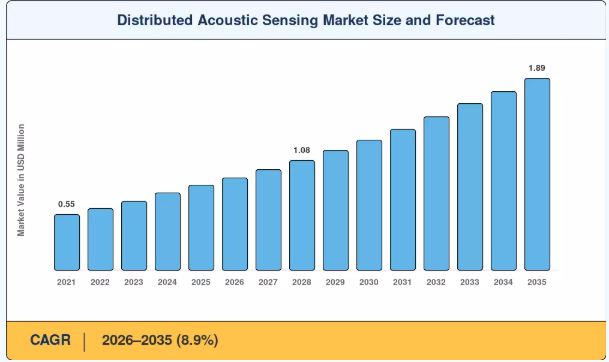
The global Distributed Acoustic Sensing Market size is expected to surge from its foundational base, mimicking the rapid scaling seen in fiber optic sensing and critical infrastructure monitoring platforms, as it rides a wave of steady Compound Annual Growth Rate (CAGR) in specific distributed vibration detection hardware segments and an overall robust CAGR in digital pipeline monitoring integration. The distributed acoustic sensing market reached an estimated USD 0.84 billion in 2025 and is forecast to climb from USD 0.91 billion in 2026 to USD 1.89 billion by 2035, registering a CAGR of 8.9% across the forecast window.
Get Full PDF Sample Copy of Report: (Including Full TOC, List of Tables & Figures, Chart) @
https://www.marketresearchfuture.com/sample_request/9689
✿ Key Drivers Fueling Market Growth
The convergence of three distinct regulatory, technological, and infrastructural pillars is accelerating the expansion of the distributed acoustic sensing market:
Pipeline Integrity Regulation & Compliance Mandates:
The U.S. Pipeline and Hazardous Materials Safety Administration’s (PHMSA) Mega Rule, entering Phase-II enforcement in 2026, requires operators of gas transmission and hazardous-liquid pipelines to implement continuous leak-detection technologies across previously unregulated gathering lines totaling an estimated 425,000 miles.
Pipeline acoustic sensing is one of only three approved technology categories under the rule, creating a captive addressable base worth an estimated USD 280 million in incremental hardware spend between 2026 and 2030. Simultaneously, the European Union’s revised Trans-European Networks for Energy (TEN-E) regulation earmarks EUR 5.8 billion for smart infrastructure monitoring between 2025 and 2030, converting DAS fiber optic sensing from a niche surveillance tool into a compliance necessity across both geographies.
✿AI-Enhanced Acoustic Classification & False-Alarm Reduction:
Machine-learning models trained on labeled acoustic signatures now distinguish pipeline leaks from benign thermal transients with accuracy rates exceeding 90%, reducing false-alarm rates by roughly 75% compared with legacy threshold-based systems. Operators report that distributed vibration detection systems paired with deep-learning classifiers cut mean time to leak localization from 45 minutes to under 3 minutes.
A single fiber acoustic monitoring deployment can replace upward of 5,000 discrete point sensors, cutting installation labor by an estimated 60%. By 2030, more than 60% of new DAS installations are expected to ship with embedded edge-AI processors capable of classifying 15 or more acoustic event types without cloud connectivity, transforming distributed acoustic sensing into an autonomous real-time decision layer for critical infrastructure operators.
✿High-Speed Rail Expansion & Critical Infrastructure Fiber Build-Out:
China’s State Railway Group plans to add 16,000 km of high-speed track by 2030, with fiber acoustic monitoring embedded as a standard specification for ballast-integrity surveillance and intrusion detection. India’s Dedicated Freight Corridor Corporation has similarly mandated distributed acoustic sensing along its 3,360-km Eastern and Western corridors.
Beyond rail, Europe’s offshore wind capacity is set to reach 120 GW by 2030, with each turbine array connected by 50–150 km of subsea export cables requiring continuous seismic DAS system monitoring for anchor strike and seabed movement detection—representing an incremental USD 95 million opportunity for the distributed acoustic sensing market by 2030.
✿ Market Segmentation Analysis
To provide a granular understanding of the landscape, global market research highlights a comprehensive segmentation across several key domains:
1. By Technology
Interferometric Fiber Optic Sensing: The leading technology segment, leveraging coherent optical interference patterns to detect sub-nanometer fiber perturbations, enabling ultra-high spatial resolution distributed vibration detection across long-haul pipeline and subsea cable monitoring deployments.
Time-Domain Optical Reflectometry (OTDR): The most widely deployed baseline technology in existing DAS infrastructure, offering cost-effective acoustic event localization across pipeline corridors by analyzing Rayleigh backscatter return pulses in the time domain.
Frequency-Domain Optical Reflectometry (OFDR): An advanced high-resolution variant enabling sub-centimeter spatial resolution at shorter measurement ranges, increasingly adopted in structural health monitoring and precision seismic DAS system applications requiring fine-grained acoustic event localization.
2. By Application
Pipeline Monitoring - The dominant application segment, driven by PHMSA and EU TEN-E regulatory mandates requiring continuous leak-detection and acoustic integrity surveillance across hazardous-liquid and gas transmission pipeline networks globally.
Perimeter Security - The fastest-growing application segment, expanding at an 11.1% CAGR, fueled by border protection programs, hyperscale data-center intrusion detection requirements, and critical-facility perimeter surveillance deployments where DAS fiber optic sensing provides cost-effective, kilometer-scale coverage.
Oil and Gas Exploration - A core upstream application where distributed acoustic sensing enables real-time wellbore integrity monitoring, microseismic event detection during hydraulic fracturing, and production optimization through continuous acoustic log acquisition in live wells.
Seismic Monitoring - A rapidly expanding application leveraging seismic DAS systems for earthquake early warning, geotechnical hazard assessment, and subsurface characterization, increasingly adopted by national geological survey agencies and civil infrastructure operators.
Structural Health Monitoring - An emerging application deploying fiber acoustic monitoring along bridges, tunnels, dams, and high-rise buildings to continuously detect structural anomalies, fatigue crack propagation, and dynamic load events, supporting smart-city infrastructure resilience programs.
3. By Component
Hardware: Accounted for 64% of the distributed acoustic sensing market revenue in 2024, reflecting strong demand for interrogator units—which command USD 120,000–USD 250,000 per installation—and associated fiber-optic cable infrastructure across new pipeline and rail corridor deployments.
Software: Encompasses AI-powered acoustic event classification platforms, digital-twin integration middleware, and edge-processing firmware, with software analytics increasingly bundled into multi-year subscription contracts that generate recurring revenue streams for leading DAS vendors.
Services: Advancing at a 12.0% CAGR through 2035, driven by the rapid expansion of managed DAS-as-a-Service (DaaS) models, 24/7 alarm-center monitoring contracts, and pipeline acoustic sensing analytics subscriptions targeting mid-tier operators seeking opex-based deployment alternatives.
4. By Fiber Type
Single-Mode Fiber: Held a dominant 76% share of the distributed acoustic sensing market in 2024, preferred for long-haul pipeline monitoring, subsea cable surveillance, and rail corridor deployments where low optical attenuation over spans exceeding 40 km is critical for cost-effective system design.
Multi-Mode Fiber: Adopted primarily in short-range, high-density applications such as data-center perimeter security, building structural monitoring, and industrial facility intrusion detection, where its lower cost and existing multi-mode fiber infrastructure assets reduce total deployment expenditure.
5. By Deployment Mode
Permanent Deployment: The dominant mode, accounting for the majority of distributed acoustic sensing market revenue, representing long-cycle capex commitments from pipeline operators, rail authorities, and grid infrastructure owners that install fiber acoustic monitoring as a permanent operational system integrated with SCADA and asset-management platforms.
Temporary Deployment: A growing segment for rapid-response pipeline inspection, short-duration seismic survey campaigns, and construction site monitoring, offering rental-based interrogator access and portable DAS fiber optic sensing systems that reduce capital commitment for project-specific monitoring requirements.
Get access to the full description of the report @
https://www.marketresearchfuture.com/reports/distributed-acoustic-sensing-market-9689
✿ Regional Insights
North America: North America commands the largest regional share at approximately 38% of the distributed acoustic sensing market in 2024, anchored by aggressive pipeline integrity spending across the United States and Canada. PHMSA’s Mega Rule Phase-II enforcement in 2026 is directly converting regulatory compliance pressure into active distributed vibration detection procurement across Permian Basin and Gulf Coast pipeline corridors.
Data-center perimeter security buildouts in Virginia, Texas, and Oregon further supplement demand, as hyperscale operators adopt DAS fiber optic sensing as a cost-effective alternative to discrete intrusion detection arrays spanning multi-kilometer campus perimeters.
Asia-Pacific: Asia-Pacific is the fastest-growing region, registering a CAGR of 10.8% between 2026 and 2035—the highest among all geographies—propelled by China’s 16,000-km high-speed rail expansion program, India’s Dedicated Freight Corridor fiber mandates, and smart-city infrastructure rollouts across Southeast Asian urban centers.
China and India collectively represent the largest pipeline acoustic sensing procurement base outside North America, while Vietnam, Indonesia, and the Philippines have committed a combined USD 48 billion in rail infrastructure investment through 2035, injecting long-cycle DAS system demand into the regional supply chain.
Europe: Europe holds the second-largest share at approximately 27% of global distributed acoustic sensing market revenue, driven by offshore wind-farm subsea cable monitoring across the North Sea, Baltic, and Celtic Sea basins, and seismic DAS system deployments supporting the continent’s aggressive renewable energy infrastructure expansion.
The EU’s EUR 5.8 billion TEN-E smart infrastructure monitoring commitment, combined with the Corporate Sustainability Reporting Directive’s mandatory ESG disclosure requirements for pipeline operators, is generating a compliance-driven pull for auditable fiber acoustic monitoring solutions that directly supports Scope 1 fugitive emission reporting.
Middle East & Africa and South America: The Middle East & Africa region represents a significant near-term growth corridor, driven by GCC nations’ large-scale border security infrastructure programs and critical oil and gas pipeline monitoring requirements across extensive desert terrain where fiber acoustic monitoring provides surveillance coverage economically infeasible with discrete sensor arrays.
South America presents a longer-term opportunity, with Brazil’s pre-salt offshore pipeline network and Andean seismic activity monitoring programs creating initial distributed acoustic sensing market traction, though high upfront interrogator costs and a shortage of certified DAS deployment engineers currently moderate near-term adoption velocity.
✿ Top Key Companies:
The global distributed acoustic sensing landscape is consolidated around oilfield services majors, specialist photonics firms, and fiber sensing technology innovators, which include:
➤Halliburton: A dominant oilfield services leader integrating distributed acoustic sensing into its wellbore diagnostics and production optimization platforms, delivering real-time fiber acoustic monitoring across upstream oil and gas exploration and permanent downhole sensing applications worldwide.
➤Schlumberger (SLB): A global leader combining advanced photonic interrogator technology with AI-powered acoustic event classification to deliver comprehensive DAS fiber optic sensing solutions for well integrity monitoring, seismic acquisition, and pipeline surveillance across international energy markets.
➤Baker Hughes: A major energy technology company deploying distributed vibration detection systems for permanent downhole monitoring, hydraulic fracturing diagnostics, and integrity surveillance across subsea and surface pipeline infrastructure in global energy operations.
➤Fotech Solutions (BP): A specialist DAS technology provider backed by BP, pioneering AI-enhanced pipeline acoustic sensing and perimeter security solutions that combine high-sensitivity fiber optic distributed sensing with real-time machine-learning event classification for critical infrastructure protection.
➤OptaSense (Luna Innovations): A leading DAS platform provider delivering commercial pipeline monitoring, oil and gas wellbore diagnostics, and transport infrastructure security solutions, known for its QuantX interrogator platform and long-range distributed vibration detection capabilities.
➤Silixa: An international distributed acoustic sensing specialist pioneering ultra-high-sensitivity iDAS and CONSTELLATION fiber sensing systems for seismic monitoring, production logging, and pipeline integrity applications, with particularly strong credentials in demanding subsea and geothermal environments.
➤AP Sensing: A German fiber optic sensing technology leader delivering distributed temperature and acoustic sensing solutions for power cable monitoring, tunnel safety, and pipeline infrastructure surveillance, with a strong presence in European utility and transport markets.
➤Omnisens: An international distributed sensing innovator offering DITEST and BOTDA-based fiber acoustic monitoring solutions for pipeline leak detection, power transmission cable monitoring, and geotechnical hazard assessment across industrial and utility infrastructure globally.
✿ Emerging Trends and Future Outlook
The future of the distributed acoustic sensing market lies in the breakdown of silos between macro-infrastructure risk monitoring and micro-device level fiber optic signal intelligence. Industry leaders are focusing on creating cohesive digital environments where a DAS interrogator doesn’t just record acoustic waveforms, but continuously generates real-time asset health telemetry via integrated edge-AI processors and cloud-connected analytics platforms.
This data simultaneously allows pipeline operators, rail authorities, and grid infrastructure owners to refine predictive maintenance models and proactively trigger automated protective responses—valve shutdowns, security lockdowns, or maintenance dispatches—within seconds of detecting an anomalous acoustic signature.
As carbon-capture pipeline networks, hydrogen transport infrastructure, and HVDC interconnectors emerge as major new infrastructure asset classes under the global energy transition, distributed acoustic sensing will expand its addressable market well beyond its oil and gas origins. The IEA projects that autonomous pipeline monitoring enabled by fiber acoustic monitoring and AI classification could prevent USD 1.2 billion in annual leak-related losses globally.
Combined with growing ESG disclosure obligations under the EU’s Corporate Sustainability Reporting Directive and the SEC’s climate-risk rules—which demand auditable, time-stamped acoustic evidence of pipeline integrity for Scope 1 emissions reporting—the distributed acoustic sensing market is structurally positioned to grow as both a compliance tool and a performance optimization platform through 2035 and beyond.
✿ FAQs
Q – How do AI-enhanced acoustic classification tools affect the total addressable market for distributed acoustic sensing?
Ans – AI-powered acoustic event classification lowers the operational barriers for infrastructure operators by reducing false-alarm rates by approximately 75% and cutting mean leak localization time from 45 minutes to under 3 minutes. Over a multi-year horizon, this performance improvement vastly expands market penetration, enabling cost-sensitive utilities, municipal water authorities, and mid-tier pipeline operators to justify DAS fiber optic sensing deployments they would otherwise defer due to high interrogator capital costs and data management complexity.
Q – What core methodologies should operators verify before deploying distributed acoustic sensing systems for long-haul pipeline integrity monitoring?
Ans – Operators must evaluate fiber attenuation budgets across the full pipeline span—accounting for the practical 40–80 km sensing range per interrogator imposed by 0.2 dB/km single-mode fiber attenuation—simulate distributed vibration detection performance under worst-case electromagnetic interference and temperature cycling conditions, and validate AI classification model accuracy against site-specific acoustic baseline signatures before commissioning. PHMSA compliance verification and alignment with applicable IEC fiber sensing standards are non-negotiable prerequisites for deployments on regulated hazardous-liquid and gas transmission pipeline assets.
➤➤➤ Featured Insights from Market Research Future:
Predictive Emission Monitoring System Market -
https://www.marketresearchfuture.com/reports/predictive-emission-monitoring-system-market-8005
Biometrics In Government Market -
https://www.marketresearchfuture.com/reports/biometrics-government-market-8035
Webcam Market -
https://www.marketresearchfuture.com/reports/webcam-market-8044
Smart Beacon Market -
https://www.marketresearchfuture.com/reports/smart-beacon-market-8181
Ssd Controller Market -
https://www.marketresearchfuture.com/reports/ssd-controller-market-8268
Wireless Iot Sensors Market -
https://www.marketresearchfuture.com/reports/wireless-iot-sensors-market-8269
Dimmers Market -
https://www.marketresearchfuture.com/reports/dimmers-market-8334
Reram Market -
https://www.marketresearchfuture.com/reports/reram-market-8400
Wafer Fabrication Market -
https://www.marketresearchfuture.com/reports/wafer-fabrication-market-8401
Ai In Insurance Market -
https://www.marketresearchfuture.com/reports/ai-in-insurance-market-8465
Sagar Kadam
Market Research Future
+ +1 628-258-0071
email us here
Visit us on social media:
LinkedIn
Facebook
X
Legal Disclaimer:
EIN Presswire provides this news content "as is" without warranty of any kind. We do not accept any responsibility or liability for the accuracy, content, images, videos, licenses, completeness, legality, or reliability of the information contained in this article. If you have any complaints or copyright issues related to this article, kindly contact the author above.
